
Magic Museum
Gogia Pasha
The Gilly Gilly Man
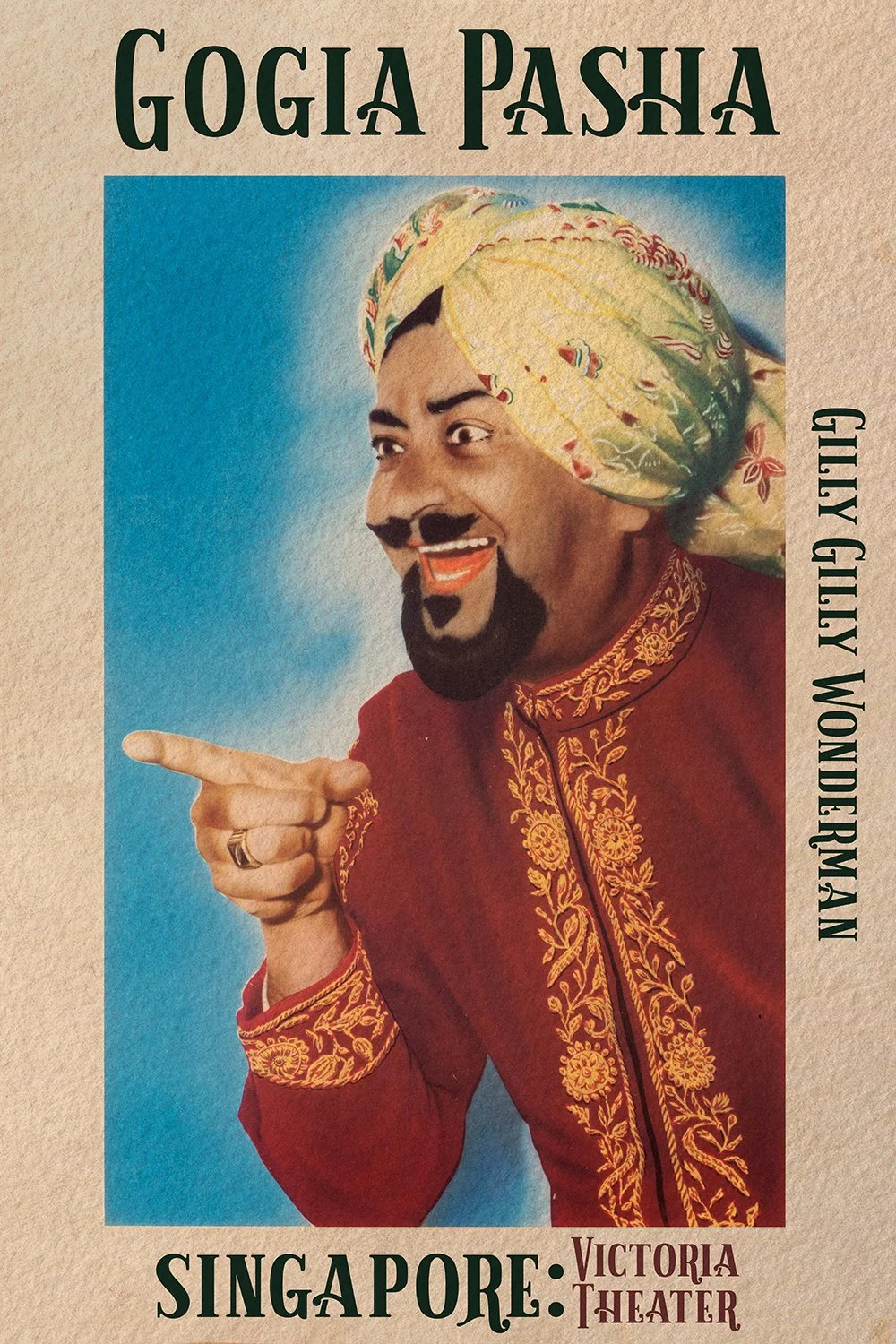
Many magicians around the globe have become famous by pretending to be from a far-off land. Gogia Pasha pretended to be an Egyptian for most of his career. He was born Danpat Rai Gogia in 1910 in the Multan district of Pakistan, and after partition, he moved to Dehradun.
From Jeweler's Son to Conjurer
His father was a Minakari jeweler whose failing business problems left the family in debt. Gogia moved to England, where he took up conjuring after watching a performance by a British magician in the late 1920s.
After the show, he went up to the performer and suggested how to improve some of his tricks. The English magician made him his apprentice and left him his equipment when he died in 1929.
Gogia returned to India and added "Pasha" to his name. He grew a goatee, giving him a slightly wicked look, donned a turban and shimmering robes, and became known as the "Gilly Gilly" man — after the Egyptian slang for magic.
A Real Showman
"A Hindu with a sense of humour and the ability to mix with the gang and be a regular fellow instead of a princely parader. Gogia was a real showman and sold his stuff well."— Gene Gordon, co-founder of the International Brotherhood of Magicians, 1956
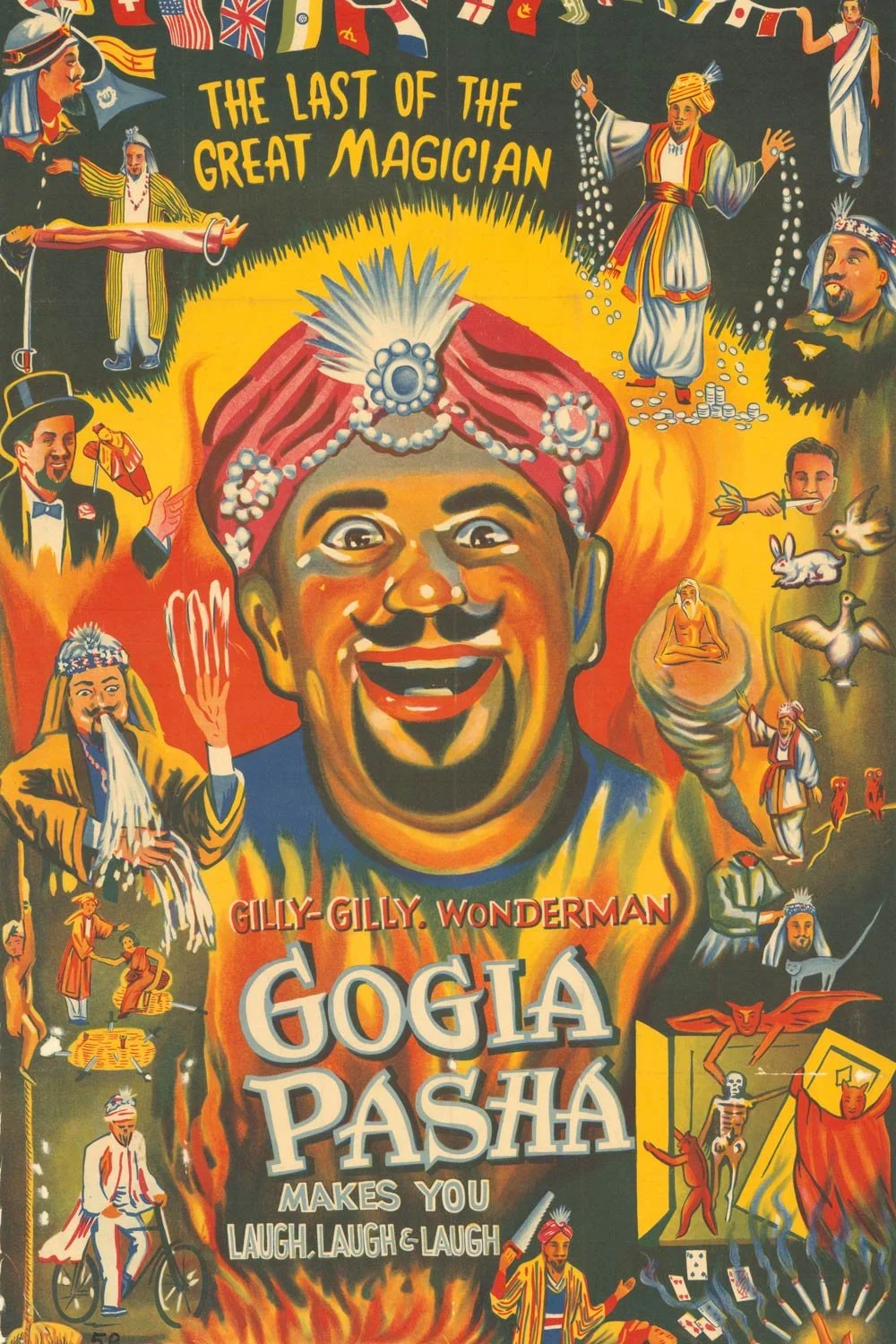
Gogia's signature acts included Cups and Balls, producing live chickens from his mouth, and a levitation feat where his assistant was placed upon the points of three swords — two of which were removed, leaving only one under her neck to support her.
The Granville Theatre, London — 1936
A review of his show at the Granville Theatre in London in 1936 referred to him as a "Port Said conjurer":
"Ball swallowing and palming lead up to the production of a string of flags from the mouth, after which there is an exhibition of marksmanship involving the use of a bow and arrows. Then the round-sided flat-bottomed basket of the Indian street conjurer is introduced, and into this, a young native inserts himself. A cloth is then thrown over the basket; Gogia squats in the center of it all, to prove that one cannot get a quart into a pint pot, after which a businesslike sword is plunged through and through the basket, but we breathe a sigh of relief when a moment later the dusky helper emerges unscathed."
The show concluded with Gogia mingling and interacting with the audience, producing cascades of coins from beards and sleeves and "various articles of intimate feminine attire" from one gentleman's waistcoat — a revelation that "vastly amused the ladies of Walham Green."
A Global Career
After the war, Gogia toured extensively throughout Europe, Asia, and Australia. While in Germany, he presented a coin act called The Man with the Hundred Million Dollars to Adolf Hitler, who reportedly enjoyed it so much he jokingly asked him to become the Reich's treasurer.
In the 1950s he began calling himself the "World Renowned Egyptian Master of Magic" and "The World's Greatest Entertainer." In 1953, he was elected president of the Indian Magicians' Club and three years later was the headline act at the 1956 IBM Convention in Miami, Florida.
A Spectacular Program
His program was an amalgam of western and Asian-style magic. It included:
He continued performing until his death in 1976. Among the many famous people he performed for were the Beatles.
Experience the Wonder
The spirit of showmen like Gogia Pasha lives on at the San Francisco Magic Theater. See the magic for yourself.
Get Tickets